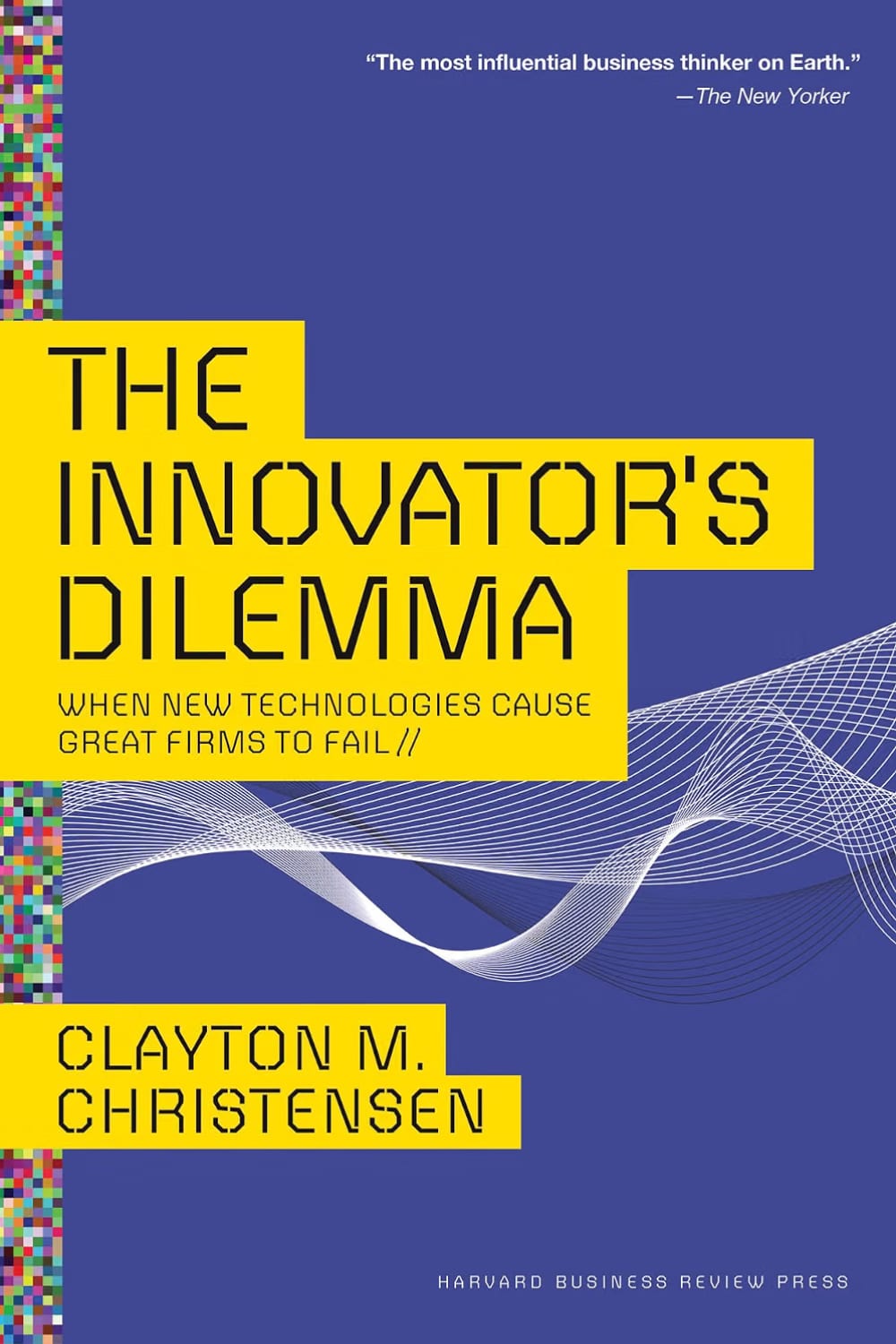
The Innovator's Dilemma answers a question that mystified the business world for years: why do outstanding, well-managed companies do everything right and still lose their market leadership, or disappear entirely? Clayton Christensen's answer is disruptive technology. Established companies excel at improving products for their best, most demanding customers, but that same discipline makes them structurally unable to respond when a smaller competitor introduces a simpler, cheaper technology at the low end of the market, one that eventually improves enough to take over from above.
Favorite Quote
"Disruption is a process, not an event, and innovations can only be disruptive relative to something else." ~ Clayton M. Christensen
Key Takeaways
- Sustaining innovations improve products for existing customers along dimensions they already value. Disruptive innovations target a different, often overlooked, customer base with something simpler and cheaper.
- Listening closely to your best customers, usually held up as good management, can be exactly what blinds a company to a disruptive threat.
- Disruptive technologies almost always look unattractive to incumbents at first: lower margins, smaller markets, inferior performance by the old measures.
- Give responsibility for a disruptive technology to an organization sized to match the size of the new, smaller market, not the size of the existing business.
- Financial planning tools built for sustaining innovation actively mislead companies evaluating disruptive opportunities, since neither the market size nor the returns can be known in advance.
- The pattern repeats across totally unrelated industries, disk drives, mechanical excavators, steel, which is what makes the theory generalizable rather than a one-off story.