
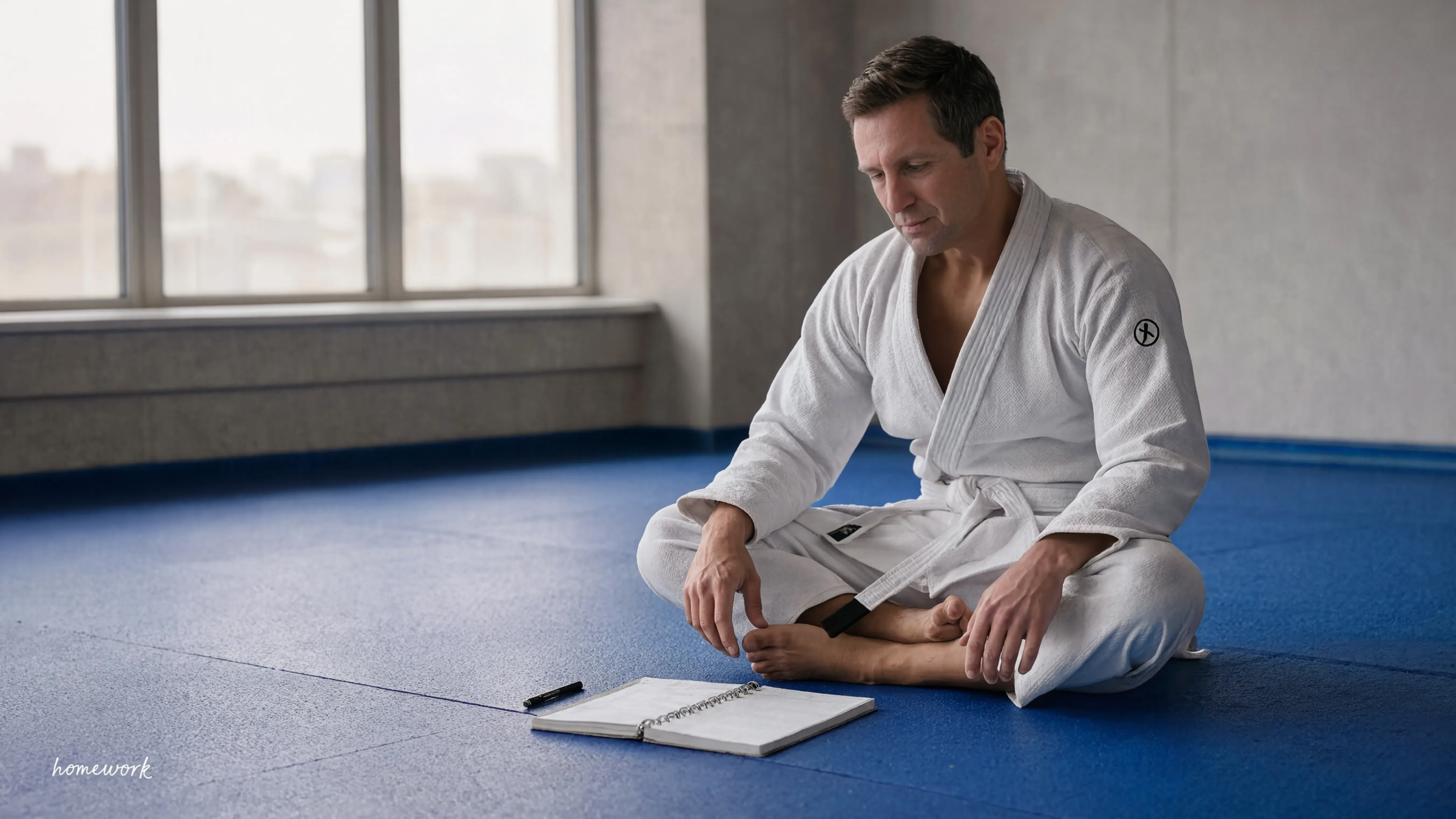
This was my first full week of really committing to jiu-jitsu. Four, five sessions, giving it everything I had. And the biggest thing I learned this week has nothing to do with any single move. I learned that I know enough to fight my way into a great position, and then I have absolutely no idea what to do once I get there. NONE.
The Discomfort of Being New
Let me back up a second, because there is a thing nobody really tells you when you start. This whole process is intimidating. If you want the truth, intimidation is a big part of what kept me from getting going for a while. And it does not magically go away after a week or two. You walk in, you bow on, and you just do not know what you are doing. I mean at ALL. That feeling sticks around for a bit, and I think that is normal.
Here is where it gets funny though. I am strong enough, and I have just enough skill at this point, that every now and then I can scrap my way into a genuinely good spot. I will be rolling and suddenly realize, hey, I am actually on top here, I am in control. And then I freeze. Completely. I sit there with a great position and I search my brain, there is nothing there, I have no idea what to do next. I am not exaggerating when I say I literally do not know what to do from here. It is one of the most frustrating feelings I have had in this whole thing. All that work to arrive somewhere good, and then nothing.
So this week I started thinking about it like a problem to solve instead of just a feeling to suffer through. I asked myself a simple question. Where do I actually end up when things are going well? When I am rolling and I find myself in an offensive spot, what does that spot usually look like? And it turns out there are basically three of them.
My Three Positions
The first is top side control (low and high). I am on top, chest to chest, pinning the other person down across their body. The second is mount, sitting up on top of them. That one happens a little less often when I roll, but it happens. And the third, probably the most common one for me, is being on top inside someone's full guard, where they have their legs wrapped around me and I am stuck in there trying to figure out my next move.
So the idea I landed on is this. What if I just knew three solid things to try from each of those three spots? Not twenty things. Not some endless library of fancy stuff I will never remember when my heart rate is at 180. Just three good options per position that I can actually reach for. That is nine things total. For a brand new no stripe white belt like me, that feels exactly right.
My Homework
Here is roughly what that looks like so far.
Inside Full Guard
Goal: Get out of full guard and into side control.
I’m starting here because this is the interesting one. You usually cannot submit anyone from inside a closed guard. The job there is not to finish, it is to get out. Beat the legs and get into either side control or mount.
Truly this is only ONE thing and honestly, this is probably the one thing I’m going to work on until it works, with anyone. The big idea, posture up so I do not get broken down, break the guard open, the standing break is the simplest one for me right now, and then pass to side control. And look at what just happened. The pass drops me right back into position number one. The three spots are not three random islands. They connect. Open the guard, pass it, land in side control or mount, and now I am right where my attacks live.
Top Side Control (low to high)
Goal: Finish with Americana, Kamura or Paper Cutter Choke.
1. The Americana. From top side control, the big idea for me is work slowly up toward the head to high top side control. Squeezing the neck with my shoulder, making it very uncomfortable for my opponent. The americana is the bread and butter in so long as I can get a good neck underhook. Slowly work that arm down to the mat, pass hands, slip my arm over the head, other arm under, bring to the side, lift. And here is the nice part, if they straighten the arm out to defend the americana, the kimura is sitting right there on the other side, so those two work as a pair.
2. The Kimura.
3. The Paper Cutter.
And if I want to keep climbing the ladder instead, I can drive a knee onto the belly and work up to mount, which improves my position before I even think about finishing.
From mount, the classic is the armbar. When they push up on me to try to get me off, that is the moment, I trap the arm and swing my leg over. If I am in the gi I can also work a collar choke. And the third one is more of an awareness thing than a move. When they buck and roll to escape, instead of fighting it I want to ride it and take their back, because a failed mount escape hands you the back almost every time.
Once I saw it laid out like that, the whole thing finally clicked, and not just the moves. The bigger realization is that if you are actually going to take this seriously, if you really want to advance, there is no way around working on this stuff at home too. It is exactly like school. You go to class, you learn some things, you practice some things, you get tested when you roll. But then what are you doing the other twenty three hours of the day? At some point you have to go home and do your homework. And the homework is this. The nine things.
Which brings me to the part I am genuinely excited about. I am getting my Smarty 2.0 grappling dummy set up at home so I can actually drill all of this. I can throw it down, get into side control, and ask myself the exact question that has been freezing me up. Okay, I am here, what the heck do I do? Americana. Okay, arm got away, kimura. Okay, let me climb to mount. Over and over until it is in my body instead of just in my head. A submission is obviously the best outcome at the end of the day, but the real win is just not freezing anymore.
Honestly, if a new person asked me for one piece of advice, this would be it. If you are going to get into this, get yourself a dummy right out of the gate. You are going to want to be goofing around at home practicing this stuff, and the sooner you can, the better.
Because here is the thing about the gym. Everybody there is super nice. Everybody clearly loves what they are doing. And everybody is better than you. That is just the deal when you start. So the question I keep coming back to is simple. I do not want to suck at this any longer than I have to. How do I get better quickly, so that it is just more fun to roll with me, so that I actually know a little of what I am doing?
This is the plan. Three positions, three options each, a rolling dummy in the garage, and a no stripe white belt finally doing his homework.